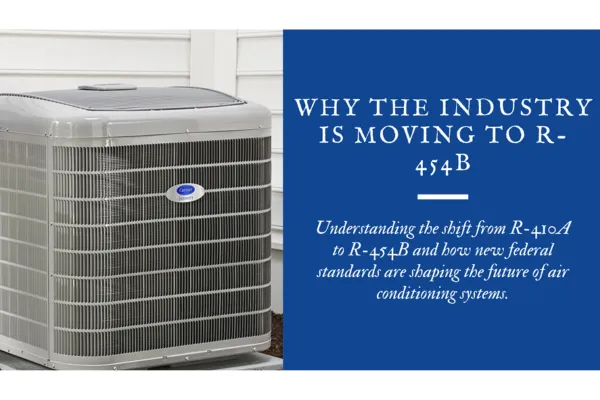
HVAC Refrigerant Changes Explained: From R-410A to R-454B
If you’ve been told your new air conditioner uses a “different kind of Freon,” you’re not alone.
Across the country, HVAC manufacturers are transitioning away from R-410A and moving toward a newer refrigerant called R-454B. If you're replacing your system in 2025 or beyond, this change will likely affect you.
Here’s a simple, homeowner-friendly breakdown of what’s changing — and why.
First, What Is Refrigerant?
Refrigerant is the fluid inside your air conditioner or heat pump that absorbs heat from inside your home and releases it outside. It’s what actually makes cooling possible.
Different generations of refrigerants have been used over time. Each change has been driven primarily by environmental regulations — not because the previous refrigerant stopped working.
A Quick History of HVAC Refrigerants
R-22 (Used Before 2010)
For decades, R-22 was the standard. It cooled homes reliably but was later discovered to damage the ozone layer. It was officially phased out in 2020.
If your system still uses R-22, repairs can be expensive because the refrigerant is no longer manufactured.
R-410A (Used 2010–2024)
R-410A replaced R-22 because it doesn’t harm the ozone layer. It became the standard refrigerant in modern systems for over a decade.
However, while it’s ozone-safe, it has a high Global Warming Potential (GWP). That means if it leaks into the atmosphere, it contributes significantly to climate change.
Because of new environmental regulations, R-410A is now being phased down.
R-454B (The New Standard Starting 2025)
R-454B is the next-generation refrigerant being adopted by major HVAC manufacturers.
Here’s why:
It has about 78% lower global warming potential than R-410A.
It performs similarly in efficiency and cooling capacity.
It meets new federal environmental requirements under the AIM Act.
In short: It cools your home just as effectively but has a much lower environmental impact.
Why the Industry Is Upgrading to R-454B
The shift isn’t because R-410A systems suddenly stopped working well. It’s driven by:
1. Federal Environmental Regulations
The American Innovation and Manufacturing (AIM) Act requires manufacturers to reduce high-GWP refrigerants over time. R-410A’s GWP is too high to meet long-term targets.
2. Lower Environmental Impact
R-454B has a GWP of around 466 compared to over 2,000 for R-410A. That’s a major reduction in potential climate impact.
3. Long-Term Availability
As R-410A production decreases, it will likely become more expensive over time — similar to what happened with R-22.
Installing a system using R-454B helps future-proof your investment.
Common Homeowner Questions
Can I upgrade my current system to R-454B?
No. Refrigerants are not interchangeable. Systems are specifically designed for the refrigerant they use. Converting an R-410A system to R-454B would require replacing the equipment.
Is R-454B safe?
Yes. It is classified as mildly flammable (A2L), which means it requires updated safety standards in system design. Manufacturers have engineered new systems to meet these standards safely.
For homeowners, it does not change day-to-day operation.
Should I replace my R-410A system now?
Not necessarily.
If your R-410A system is running well, there’s no urgent need to replace it. But if you’re already planning a system upgrade, it makes sense to consider a unit designed for R-454B to stay aligned with future regulations.
What This Means for Your Next HVAC Replacement
If you're installing a new system in 2025 or later, expect it to use R-454B or another low-GWP alternative.
The cooling performance will feel the same.
The efficiency ratings will be comparable.
The difference is primarily environmental compliance and long-term refrigerant availability.
The Bottom Line
The move to R-454B is about environmental responsibility and regulatory compliance — not about fixing a broken system.
For homeowners, the most important takeaway is this:
Older R-22 systems are costly to maintain.
R-410A systems are still fine today but will slowly phase down.
New systems using R-454B are designed to meet the future.
If you're unsure what refrigerant your current system uses, a licensed HVAC technician can confirm it quickly and explain your best options moving forward.
📱Call Us: 972-291-8002
💻Website:cozydair.com
📧Email:[email protected]
Related Article:How Much Does a New HVAC System Cost in Dallas 2025?|What to Expect After HVAC Installation? ( And How to Avoid Frustration)

